
Articles and Information
News and Information About Agriculture
Search applies to visible posts only. Load more to expand search results.
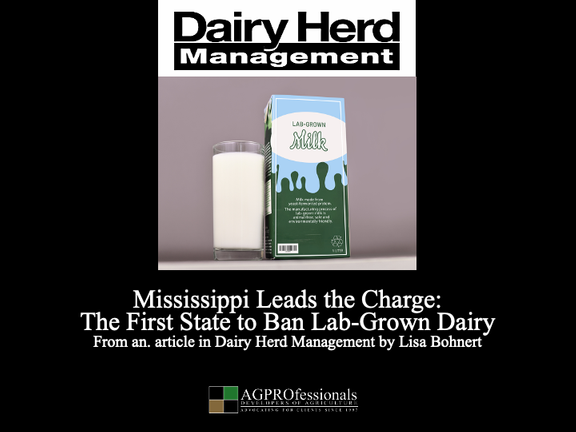
Mississippi Leads the Charge: The First State to Ban Lab-Grown Dairy
From an article in Dairy Herd Management by Karen Bohnert
Several years ago, lab-grown dairy — produced through precision fermentation or cell-culturing techniques — emerged as a high-tech disruptor in the food industry. Startups and venture capitalists positioned these products as sustainable, animal-free alternatives to traditional milk, garnering significant media attention. However, U.S. dairy producers were quick to push back, dismissing these innovations as “fake milk.” Now, that initial momentum is hitting a legislative wall as states move to protect their agricultural heritage.
Mississippi’s Landmark Ban
Mississippi has officially become the first state in the U.S. to explicitly ban cell-cultured dairy products. This follows the passage of HB 1153, a bill that broadens the legal definitions of meat, manufactured protein, cultivated protein, insect protein, plant protein and cell-cultured dairy.
The legislation is designed to prevent the misbranding of dairy products and establishes strict labeling requirements and inspection authorities. Most notably, the law implements an outright ban on the manufacture, sale and distribution of lab-grown dairy products within the state.
Key Provisions of HB 1153
- Effective Date: July 1, 2026.
- Penalties: Violators face a fine of $500 per violation per day, with a maximum penalty of $10,000.
- Enforcement: The bill grants updated authority to state inspectors to ensure compliance and prevent “fake milk” from reaching shelves.
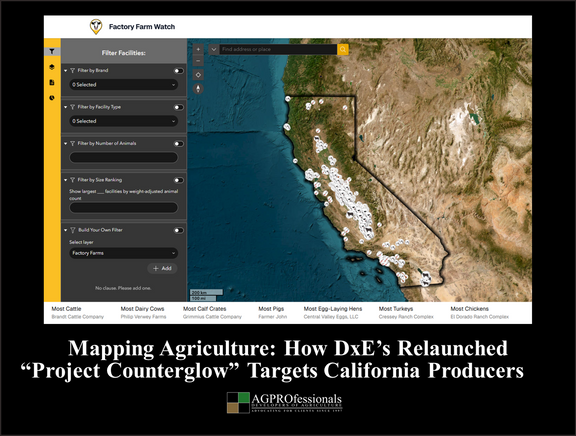
Mapping Agriculture: How DxE’s Relaunched “Project Counterglow” Targets California Producers
AGPROfessionals News Desk
The animal rights group Direct Action Everywhere (DxE) has renewed its controversial mapping project, this time focusing on California agriculture through its “Factory Farm Watch” platform. DxE’s current California map builds on its earlier Project Counterglow map and database, which compiled and published the locations of tens of thousands of farms, ranches, and animal-related facilities across the United States. That project explicitly aimed to help activists “communicate, collaborate, and network” more effectively in pursuit of animal liberation goals.
The relaunch follows the same approach, but now with increased accuracy. The California-focused platform maps over 1,300 livestock operations, linking them to brands, emissions estimates, and activist-created narratives about animal care and environmental impact. DxE-aligned media openly states the purpose behind these mapping efforts: to support “coordinated activism” and put more pressure on the livestock industry.
Disinformation by Design
The Factory Farm Watch platform and its partner ecosystem, including FactoryFarms.org, heavily rely on narrative framing that misrepresents modern animal agriculture. The map attempts to “expose” links between farms and brands, implying that consumers are being misled. DxE claims that large operations can still be certified under animal welfare programs, suggesting those certifications are meaningless. This is a typical activist tactic: making the false claim that large modern farms neglect and mistreat animals while ignoring the most basic measurable welfare outcomes. It is a fundamental fact that when animals are mistreated or living under stress, they do not produce. Their claims completely ignore successful animal husbandry practices, nutritional management, veterinary care, and oversight.
more
There is a New Group Misleading Lawmakers About Prop 12
AGPROfessionals News Desk
There’s a New Group Misleading Lawmakers About Proposition 12
As Congress considers blocking California Proposition 12 through the Farm Bill, a small group called “American Meat Producers” has surfaced to oppose efforts to halt it. The name sounds trustworthy, suggesting it represents American livestock producers. While it implies a broad alliance of farmers and ranchers, the organization is actually small and appears to reflect a limited ideological view rather than representing most of the livestock industry that supplies the majority of America's animal protein. This group recently drew notable attention in Washington, D.C., with a fly-in and a small tractor convoy around the city.
Names are vital in agriculture. They communicate credibility, experience, and the people behind food production. When consumers hear names like “National Pork Producers Council,” “National Cattlemen’s Beef Association,” or “American Farm Bureau Federation,” they reasonably believe these groups represent farmers and ranchers who produce food.
But what happens when the name suggests one thing, while the agenda behind it shows something completely different?
Animal Rights and Animal Welfare Are Not the Same
more
AGPROfessionals Founder Tom Haren Named a 2026 “Leader in Agriculture” by Denver Business Journal
AGPROfessionals News Desk
FOR IMMEDIATE RELEASE
March 17, 2026
AGPROfessionals Founder Tom Haren Named a 2026 “Leader in Agriculture” by Denver Business Journal
Greeley, Colorado: AGPROfessionals proudly announces that Founder and CEO Tom Haren has been selected as a 2026 Leader in Agriculture by the Denver Business Journal, in partnership with Colorado Farm Bureau. The recognition honors individuals whose leadership, expertise, and service help guide and strengthen agriculture, Colorado’s second-largest economic driver.
Haren will be recognized at the Leaders in Agriculture Cocktail Reception on Thursday, March 19, 2026, from 4:30 to 6:30 p.m. at the CSU Spur – Hydro Building in Denver. The event honors agricultural leaders who have made significant contributions to the industry and the communities they serve.
With a career spanning over three decades, Haren has been a prominent voice at the crossroads of production agriculture, land use, environmental compliance, real estate, and agricultural policy. As the founder of AGPROfessionals, he has built one of the nation’s most comprehensive agricultural consulting organizations, supporting producers, agribusinesses, and rural communities across Colorado, Idaho, and throughout the United States.
more
Beyond Meat Threatened with NASDAQ Delisting
From an article in MeatingPlace by Peter Voskamp
Beyond Meat, the once leading light of the plant-based protein business world, is in danger of being delisted from the NASDAQ stock exchange because its stock price has remained under $1.00 for more than 30 days.
The company, which is in the process of removing the word “meat” from its brand moniker, received a letter of warning from NASDAQ on March 4. It has 180 calendar days — actually until August 31 — to remedy the situation or face delisting. Its closing bid price must remain at $1.00 or higher for 10 days in order to be in compliance.
The company said it is exploring its options to remain in compliance, including a possible reverse stock split.
Beyond Meat went public in 2019 and at one point was valued at $14 billion. Its peak stock price was $234.90 in July 2019.
However, sales have not been what was hoped for, with the 2025 Q3 earnings report showing a 13.3% loss in net revenue year over year, $70.2 million versus $81.0 million in 2024. The company said the revenue shortfall “was primarily driven by a 10.3% decrease in products sold, and a 3.5% decrease in net revenue per pound.”
Furthermore, the firm is hobbled by more than $1 billion in debt. Its October 2025 decision to issue more shares to address that debt caused the Beyond Meat’s stock to plummet to half its value.
more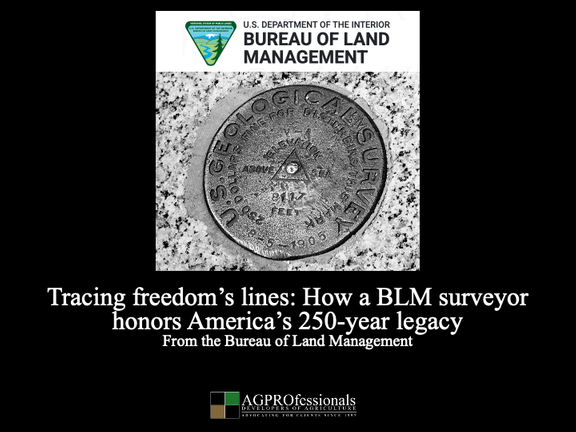
Tracing freedom’s lines: How a BLM surveyor honors America’s 250-year legacy
Shielded by a ballcap and sunglasses from the relentless Idaho sun, Gregory Hoskins pauses to survey the rugged hillside before him. Beneath the vast sky, this BLM cadastral surveyor measures more than land—he traces the enduring lines of a nation’s legacy.
As America nears its 250th anniversary, his work reminds us that our nation’s history is written in books and etched on the contours of the land.
“Every stone we uncover, every line we retrace, is a thread in the fabric of America’s freedom. Surveying isn’t just about land—it’s about preserving the promise that began 250 years ago,” says Hoskins.
A System that Built a Nation
The Public Land Survey System (PLSS), created in 1785 by Thomas Jefferson, laid the foundation for private land ownership. It created the grid that shaped settlement, commerce and public lands Americans enjoy today. By protecting original survey monuments and boundaries, Gregory continues the work begun by America’s earliest surveyors – including George Washington, who started his career in surveying before leading a revolution.
Explaining Cadastral Surveying
more
The Golden Rule of Advocacy: Why Showing Up Matters in Washington
From an article in Dairy Herd Management by Karen Bohnert
In the halls of Congress, silence is often mistaken for satisfaction. This was the sobering message delivered by Gregg Doud, president and CEO of the National Milk Producers Federation during a recent panel discussion on the dairy outlook at the High Plains Dairy Conference in Amarillo, Texas last week. Despite the pressing need for agricultural labor reform and immigration solutions, Doud warns the message isn’t reaching the ears that matter most.
The conversation, moderated by Rick Naerebout, CEO of the Idaho Dairymen’s Association, highlighted a critical gap between the industry’s needs and Washington’s perception. Despite the pressing need for agricultural labor reform and immigration solutions, Doud warns the message isn’t reaching the ears that matter most.
“I’m talking to dozens of senators about this already,” Doud notes, recounting conversations where lawmakers told him they simply aren’t hearing about ag labor from their constituents. “If that member of Congress doesn’t hear from you, he’s just going to go hang out with the guys he does hear from.”
The panel, which included Michael Dykes, DVM, president and CEO of the International Dairy Foods Association, emphasized while national organizations can “raise hell” in D.C., the real power lies in the home district.
more
Recording Now Available: Preventing Farmworker Heat Illness & Silage Pile Safety on Livestock Operations
Colorado Livestock Association
The recording of the latest CLA Safety Group webinar is now available on CLA's YouTube channel. The meeting highlighted the importance of preventing heat illness and assessing related risks on livestock operations as well as silage pile safety.
Thank you to our guest speakers Dr. Diego Manriquez, Colorado State University AgNext, and Dr. David Douphrate, Texas A&M University School of Public Health for sharing their time and expertise in order to present this important information for livestock producers and their families and employees.
View the video HERE
more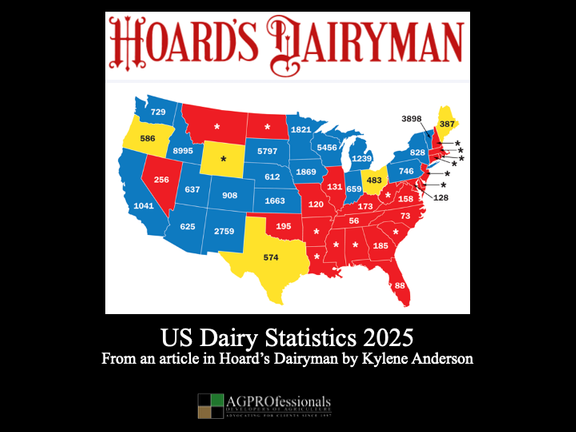
US Dairy Statistics 2025
From an article in Hoard’s Dairyman by Kylene Anderson
As the dairy industry transitioned into 2026, the 2025 USDA dairy statistics confirmed a trend that many have already observed: the U.S. dairy herd is expanding in both size and efficiency. The growth has resulted in a robust surplus of milk aacross the country. While the roster of the top 10 dairy-producing states remained largely, stable, a significant shift occurred at the top of the leaderboard. Idaho officially overtook Texas to claim the number three spot in total milk production. This milestone for the Gem State was driven by aggressive expansion, as Idaho led the nation in the number of new cows added to its herd compared to 2024.
The ”Top 10” list also saw a change in its composition with the arrival of Iowa. The Hawkeye State’s recent dairy growth has paid dividends, earning it a firm spot at number nine in national milk production rankings.
On a consumer level the sheer volume of production reached new heights. In 2025, the U.S. dairy cows produced a near-record of 678 pounds of milk for every citizen in the country. This per-capital surge was most visible in the Upper Midwest and the West. Idaho remains the outlier in this category, jumping by more than 400 pounds per resident. Meanwhile, in a surprising shift for the regional hierarchy, South Dakota climbed to the number two spot, unseating Wisconsin from its perennial second-place position. Both South Dakota and Wisconsin are now in an elite bracket, producing more than 5,000 pounds of milk per state resident.
more
Victory for Colorado Agriculture-SB 26 065 Killed After Bipartisan Rejection
AGPROfessionals News Desk
A Win for Producers and Property Rights
Colorado farmers and ranchers won a significant victory this legislative session when Senate Bill 26-065 was killed in the Senate Agriculture and Natural Resources Committee. SB 26-065 threatened to impose costly bureaucracy and undermine growers’ decision-making on agronomic inputs. It stalled in committee when two state Democratic members joined Republicans to reject the bill by a 5-2 vote. showing that agricultural realities transcended partisan lines in the face of overwhelming producer opposition. The controversial proposal would have required farmers to obtain state-mandated third-party approval before purchasing or planting seeds treated with systemic insecticides.
AGPROfessionals’ Ag Community Outreach
Through strategic outreach on AGPROfessionals’ social media outlets, website, and newsletter, we helped raise awareness of SB 26-065’s real-world impact. Our post on the topic resonated strongly within the farming and ranching community, reaching over 70,000 Colorado residents involved in agriculture.
Along with AGPROfessionals’ 30,000-subscriber newsletter reach and more than 1.4 million website visitors over the year, our organization played a key role in shaping public discussion and ensuring producers’ voices were heard at the Capitol.
more